Clean Profiles Repeated Accurately Across Every Part
Laser Cutting in Texarkana for fabrication projects requiring consistent geometry from sheet and plate materials
Shops that produce parts from sheet or plate stock consistently face the same challenge: maintaining geometry across multiple pieces so that downstream operations—bending, forming, welding, or machining—proceed without correction. Laser cutting addresses that problem directly. Eagle Cutting & Supply uses computer-controlled laser cutting to produce clean, repeatable profiles from sheet and plate materials in Texarkana, supporting both individual part orders and production quantities where consistency across a run is essential.
The laser follows a programmed path derived from customer drawings or CAD files, which removes the variability introduced by manual layout and hand cutting. Each part produced from that program reflects the same geometry as the one before it, which simplifies downstream assembly, reduces fit-up correction, and supports inspection against original specifications. For fabrication work that continues into press brake bending or secondary machining, accurate blank dimensions at the laser stage reduce compounding error through each subsequent process.
Request a quote by submitting your drawings and specifications so the team can evaluate your part geometry and material requirements.
How Laser Cutting Supports Fabrication Projects
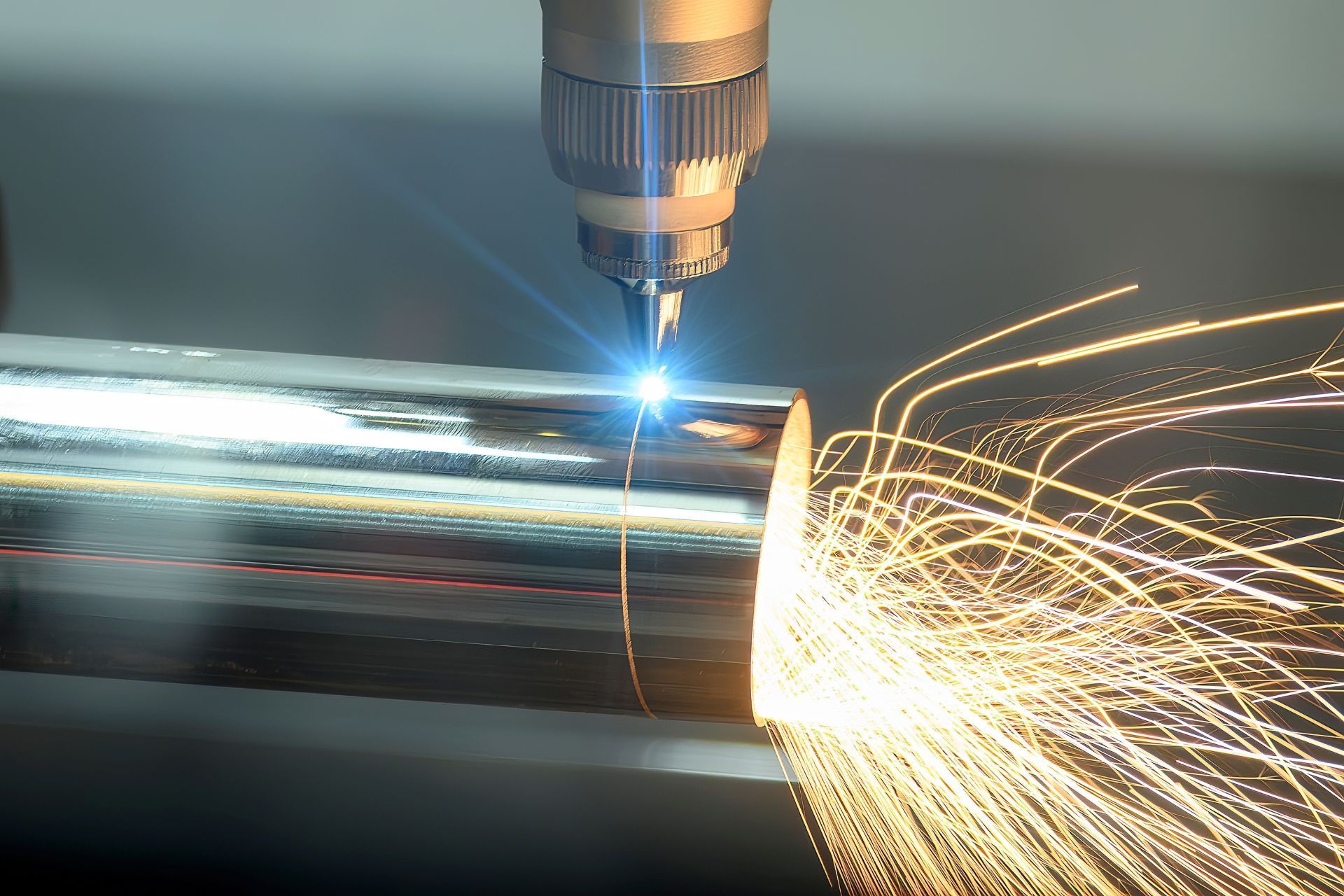
Laser cutting works by focusing a high-intensity beam onto the material surface, melting or vaporizing the stock along a controlled path while an assist gas clears the kerf. The computer-controlled motion system translates drawing geometry directly into cut paths without requiring physical templates or manual repositioning between features. That process is particularly effective for parts with multiple interior cutouts, closely spaced features, or contours that would be time-consuming to produce by hand.
Parts produced through laser cutting typically arrive with edges that require minimal cleanup before the next fabrication step. Holes, slots, and outer profiles maintain the dimensional relationships defined in the original drawing, so components nest and align as designed when moving into assembly or welding fixtures. For customers running prototypes that may transition into production, the same cut program can be reused without modification, which keeps per-part geometry consistent between early samples and later production quantities.
Material type and thickness both influence how laser cutting parameters are set, and Eagle Cutting & Supply works from customer-supplied material information to configure the process appropriately. Carbon steel, stainless steel, and aluminum each behave differently under a laser, and edge quality expectations should be discussed alongside material callouts when submitting a project. Parts that will be painted, coated, or welded directly after cutting may have different edge preparation requirements than those going into machining.
What Customers Ask Before Submitting Laser Parts
These are the questions that arise most often when fabricators and engineers are considering laser cutting for sheet and plate components.
What file formats work best for laser cutting submissions?
DXF and DWG files derived from CAD drawings give the most direct path from design to cut program—PDF drawings are workable but may require additional interpretation steps before programming begins.
How does laser cutting handle parts with both outer profiles and interior features?
The laser processes all geometry from a single program without requiring separate setups, so parts with holes, slots, notches, and complex perimeters are produced in one operation with consistent positional accuracy between features.
Why does material thickness affect laser cutting suitability?
Thicker stock requires more focused energy and slower travel speeds to maintain cut quality, and at certain thicknesses, alternative processes like waterjet may produce better edge conditions depending on the material and downstream requirements.
When is laser cutting the right choice for prototype work in Texarkana?
Laser cutting supports prototype quantities efficiently because no hard tooling is required—parts can be produced directly from drawings and evaluated before committing to production quantities.
What should customers specify when requesting a laser cutting quote?What should customers specify when requesting a laser cutting quote?
Material type, thickness, quantity, and a dimensioned drawing with all feature locations and tolerances allow Eagle Cutting & Supply to assess the project accurately and return a quote based on real part requirements.
Eagle Cutting & Supply works with fabricators, engineers, and maintenance teams to move laser cutting projects from drawing to finished blank. Bring your part files and material specifications to start the quoting process.