Precision Cuts Without Heat-Affected Zones
Waterjet Cutting in Texarkana for detailed profiles and complex shapes where thermal cutting methods create material risk
Eagle Cutting & Supply provides waterjet cutting in Texarkana for fabrication shops, machinists, and production facilities that require accurate profiles without exposing base material to heat. The process uses a high-pressure stream to cut through material mechanically rather than thermally, which means the area immediately surrounding the cut retains its original metallurgical properties. This distinction matters when working with heat-sensitive alloys, hardened steels, laminates, or parts that will undergo secondary operations like precision machining or forming.
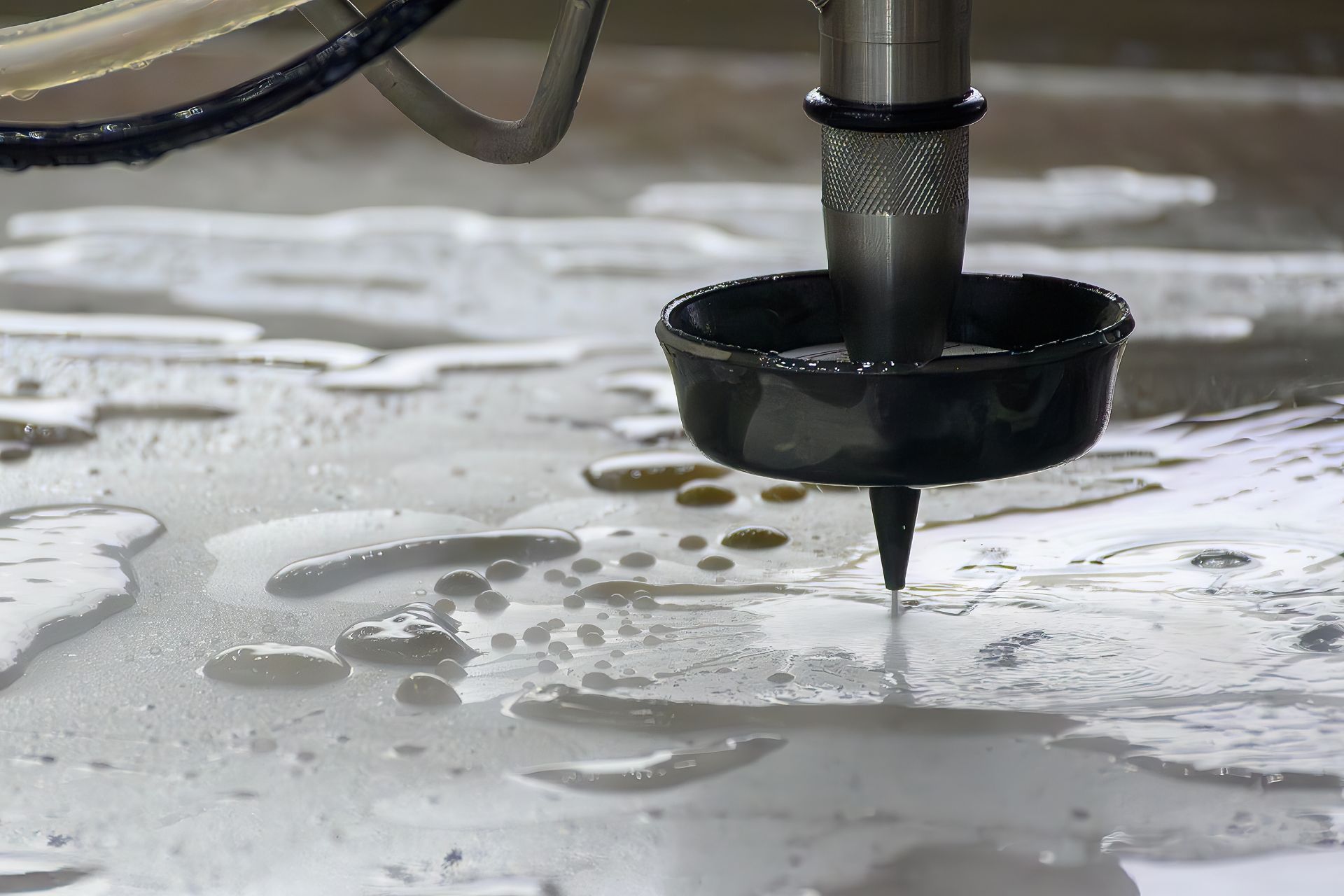
Waterjet cutting works by forcing water—typically mixed with an abrasive media—through a precisely controlled nozzle at pressures high enough to sever dense materials cleanly. The cutting path follows a programmed geometry, which allows for complex contours, interior cutouts, and tight radii that would be difficult or impractical to achieve with plasma or oxy-fuel methods. Because no heat-affected zone is introduced, parts move directly into downstream operations without requiring additional annealing, stress relief, or edge rework in most cases.
Submit your drawings or material specifications to discuss part geometry and dimensional requirements with the Eagle Cutting & Supply team..
What Waterjet Cutting Actually Accomplishes
The practical value of waterjet cutting becomes clearest when a project involves materials that react poorly to localized heating. Certain stainless grades, tool steels, aluminum alloys, and composites develop hardened edges, warped profiles, or microstructural changes when cut with thermal processes—changes that create problems during subsequent machining or assembly. Waterjet removes that variable by separating material through mechanical erosion rather than combustion or electrical arc.
After cutting, parts typically arrive with smooth, consistent edge quality that reduces the finishing work required before the next fabrication step. Complex shapes that might otherwise require multiple setups on a milling machine or saw can often be produced in a single waterjet pass, which simplifies part flow through a shop. Customers working on prototypes often find that waterjet-cut blanks are ready for immediate evaluation or fit-check without edge conditioning.
Waterjet is well-suited to one-off parts, short production runs, and projects that span different material types within the same batch. Because no tooling changes are required between cuts, switching from one material or thickness to another within a production run is straightforward. Projects that combine prototype quantities with future production intent are a natural fit, since the same programmed geometry can be re-run without additional setup investment..
Common Questions About Waterjet Cutting
The following answers address questions that come up frequently when customers are evaluating waterjet cutting for fabrication, prototype, or production work.
What materials can waterjet cutting process?
Waterjet handles a broad range of metals including steel, stainless, aluminum, copper, and titanium, as well as non-metals like plastics, composites, and rubber—material suitability depends on thickness and the specific abrasive media used.
How does waterjet cutting differ from plasma cutting for structural steel?
Plasma introduces a heat-affected zone along the cut edge that can alter hardness and create distortion in tighter-tolerance parts, while waterjet removes material without heating the workpiece, leaving edge properties closer to the original stock condition.
When does waterjet make sense over laser cutting?
Waterjet is typically preferred for thicker cross-sections, materials sensitive to heat, or projects where the cut-edge condition is critical for downstream machining—laser cutting has speed advantages on thinner sheet work.
Why do some parts cut by waterjet still require secondary operations?
Waterjet produces accurate profiles, but parts intended for press fits, bearing bores, or critical dimensional tolerances generally require finish machining to achieve the surface quality and exact dimensions those applications need.
How should customers in Texarkana submit projects for waterjet cutting?How should customers in Texarkana submit projects for waterjet cutting?
Bringing dimensioned drawings in digital format—DXF, DWG, or PDF—along with material type and thickness allows Eagle Cutting & Supply to evaluate part geometry and provide an accurate quote based on your actual project requirements.
Eagle Cutting & Supply is set up to evaluate waterjet projects from a single prototype blank through recurring production quantities. Bring your drawings and material details to discuss how the process fits your current project requirements.